Japan in focus | 3 min read | September 2026
Changes in the Japan–China–ASEAN Trade Triangle
As ASEAN becomes a connecting hub for US–China trade, the composition of exports to the region from China and Japan are growing increasingly similar
Japan in focus | 3 min read | September 2026
As ASEAN becomes a connecting hub for US–China trade, the composition of exports to the region from China and Japan are growing increasingly similar

Japan Economist
The ASEAN region, made up of 11 member states in Southeast Asia, is an important export destination for Japan. Japanese companies have production bases across the region, and they also play an upstream role by supplying intermediate and capital goods needed for local production activity. These goods — such as machinery, electrical equipment, and chemicals — account for a large proportion of Japanese exports to ASEAN, alongside automotive products.
However, Chinese exports to ASEAN have been increasing rapidly in recent years, raising growing concerns about competition with Japanese exporters.
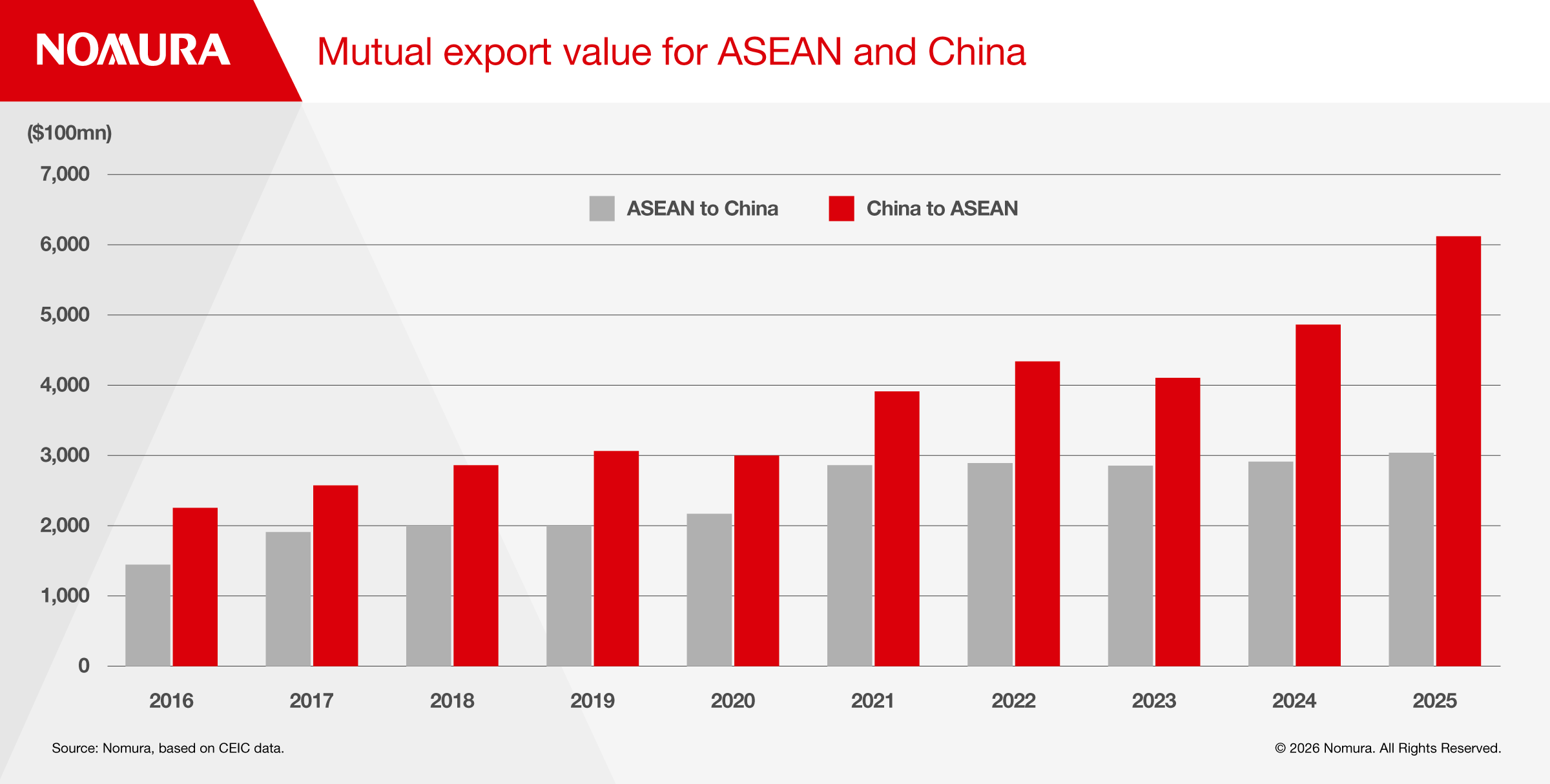
Since 2021, Chinese exports to ASEAN have risen rapidly, but ASEAN exports to China have been at a standstill (Figure 1).
It is also well known that exports from ASEAN to the US have been increasing in recent years. There is a strong correlation between growth in ASEAN exports to the US and growth in Chinese exports to ASEAN (Figure 2).
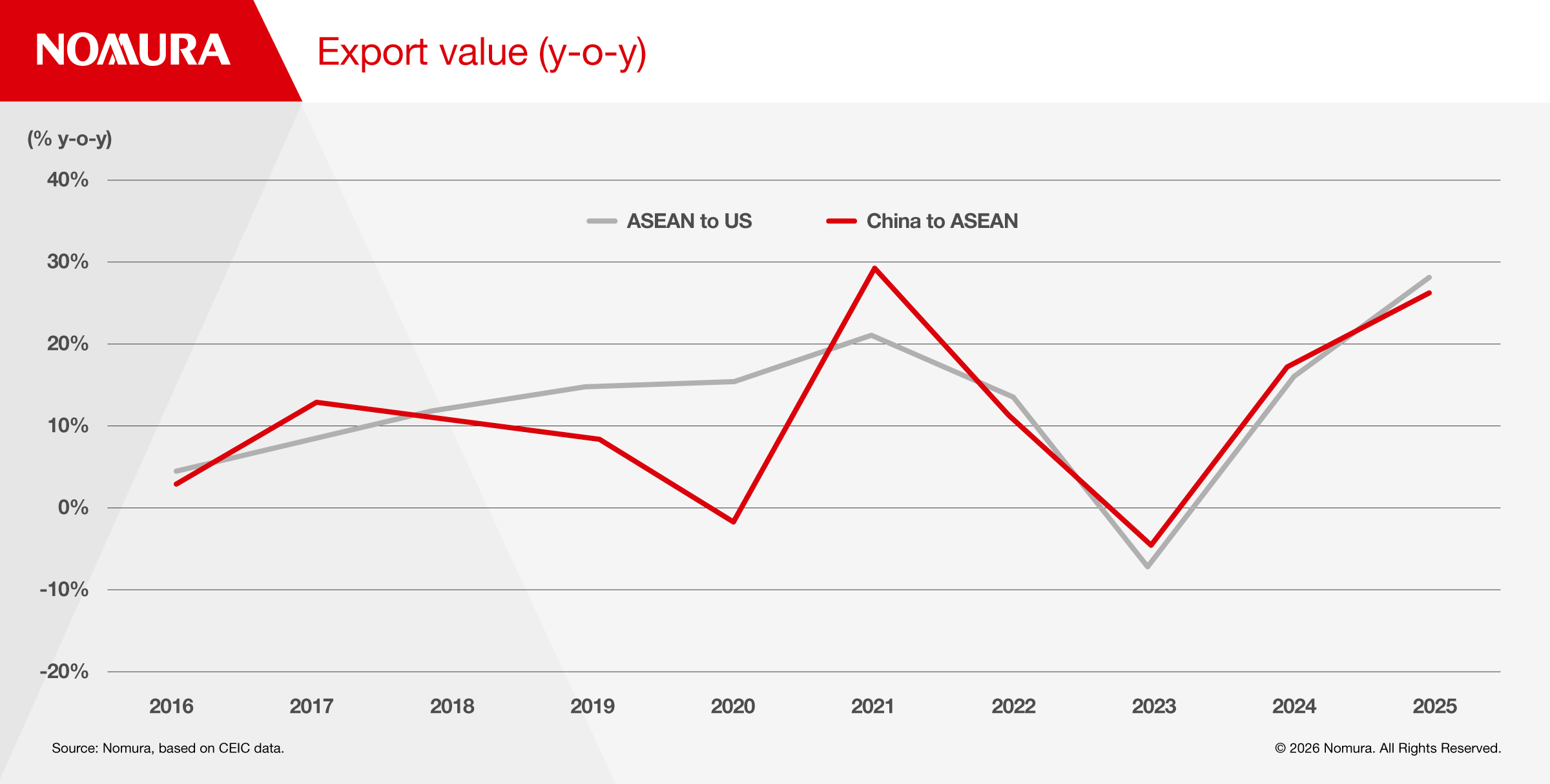
A trade flow is emerging where exports from China head to the US via the ASEAN region. This may include some transshipment exports, which involve a relabeling of the country of origin to avoid tariffs. But the US has tightened its curbs on transshipment exports since the start of the second Trump administration, so we surmise that there has been a decrease in straightforward transshipment exports.
With China relocating some of its production sites to ASEAN, it is reasonable to assume that the region is being incorporated into some parts of China’s supply chains for US-bound exports.
Chinese exports to ASEAN of final consumer goods have been flat in recent years, but exports of intermediate and capital goods have been increasing. This suggests that, for China, ASEAN is increasingly becoming a production base rather than a region of final demand.
In the past, global supply chains were characterized by countries with an advanced manufacturing industry, such as Japan, being positioned in the upstream and supplying intermediate and capital goods to China, which was located downstream. China used these goods to assemble final products, which were then exported to final demand countries such as the US.
However, in recent years, Chinese companies have been increasing their ability to supply intermediate and capital goods, and they have moved some of their final assembly processes to the ASEAN region to avoid additional US tariffs. As a result, new supply chains are being formed in which China has assumed a greater presence as an upstream supplier, while ASEAN handles downstream production and assembly.
The relationship between China and ASEAN countries is now similar to that of Japan and ASEAN, with Japan and China both being upstream and ASEAN downstream.
It is only natural that competition between China and Japan would intensify in terms of exports to ASEAN. In 2025, the two countries’ main exports to the region were broadly similar. They included electrical equipment, general machinery, and automobiles.
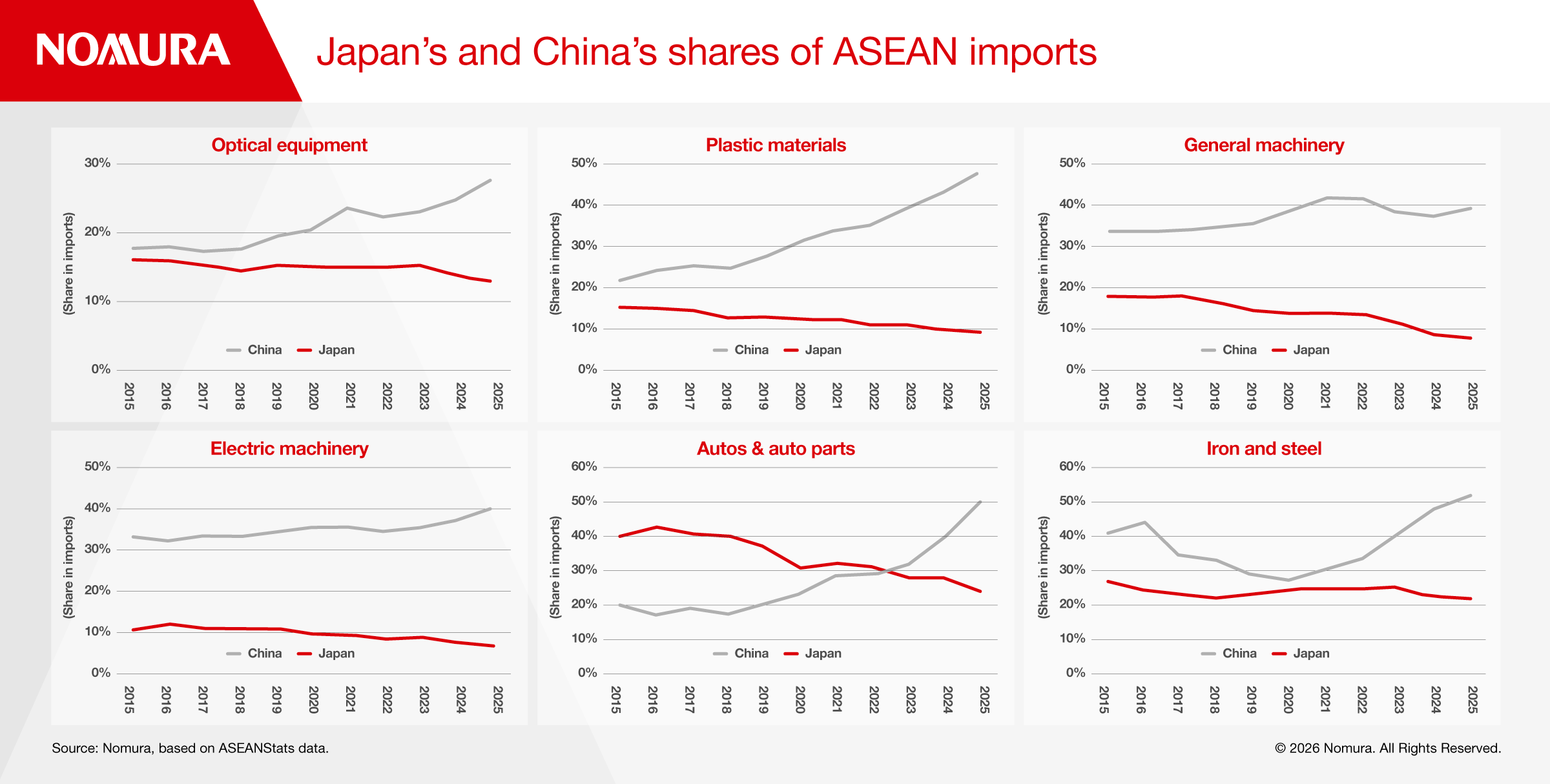
Furthermore, a breakdown of ASEAN imports from China and Japan by product category shows that in many of Japan's main export product categories, China's share is increasing, while Japan's share has been gradually declining (Figure 3).
We think ASEAN will become increasingly important as a global production and export base. However, based on our current analysis, we think it is unlikely that economic growth in ASEAN will lead to a similar level of growth in Japanese exports as in the past. Competition will become more intense with those Chinese companies that have formed supply chains between China and ASEAN, increased local production in the region, and are supplying low-priced intermediate goods.
For Japanese companies to increase exports to ASEAN, they will need to maintain and strengthen their advantages in high value-added areas where competition with Chinese companies can be avoided, rather than simply waiting for demand to rise in ASEAN.
To read the full report, click here.
Japan Economist
This content has been prepared by Nomura solely for information purposes, and is not an offer to buy or sell or provide (as the case may be) or a solicitation of an offer to buy or sell or enter into any agreement with respect to any security, product, service (including but not limited to investment advisory services) or investment. The opinions expressed in the content do not constitute investment advice and independent advice should be sought where appropriate.The content contains general information only and does not take into account the individual objectives, financial situation or needs of a person. All information, opinions and estimates expressed in the content are current as of the date of publication, are subject to change without notice, and may become outdated over time. To the extent that any materials or investment services on or referred to in the content are construed to be regulated activities under the local laws of any jurisdiction and are made available to persons resident in such jurisdiction, they shall only be made available through appropriately licenced Nomura entities in that jurisdiction or otherwise through Nomura entities that are exempt from applicable licensing and regulatory requirements in that jurisdiction. For more information please go to https://www.nomuraholdings.com/policy/terms.html.